

Retraso en el seguimiento de paquetes internacionales: ¿Cuándo debe empezar a preocuparse?
Índice
Seguimiento internacional de paquetes Los retrasos son habituales en los envíos transfronterizos. La verdadera pregunta es sencilla: ¿se trata de una fase lenta normal o de un riesgo real, como un escaneado fallido, una retención aduanera o un problema de traspaso? Utilice esta guía para leer las señales, juzgar los plazos y tomar rápidamente las medidas adecuadas.
1. Qué significa realmente un “Retraso en el seguimiento de paquetes internacionales”.
En Seguimiento internacional de paquetes El retraso no es un problema aislado. Es una etiqueta para “no hay actualización” o “más lento de lo esperado” durante un viaje que a menudo implica múltiples centros, diferentes transportistas y traspasos que no siempre crean un escaneo. A veces el paquete está en movimiento, pero la página de seguimiento permanece quieta.
La mayoría de los retrasos corresponden a una de estas categorías:
- Brecha de exploraciónEl paquete se mueve, pero aún no aparece ningún escáner.
- Retraso en la cola: se retrasan los vuelos de exportación, las aduanas o la clasificación local.
- Excepción: problemas de dirección, deberes, devolución al remitente o una ruta errónea.
1.1 Retraso vs atasco: la diferencia rápida
- Retraso: el seguimiento sigue coincidiendo con la ruta, sólo que más despacio.
- Atascado: ninguna nueva exploración durante demasiado tiempo en una fase en la que las exploraciones suelen ser frecuentes.
2. Plazos normales (y cuándo preocuparse)
Estos rangos te ayudarán a dejar de adivinar. Contar días laborables cuando sea posible.
2.1 Etiqueta creada, pero sin escaneado “aceptado
- Normal: 1-4 días
- Preocúpese: 5-7+ días
Lo que suele significar: el vendedor imprimió una etiqueta pero no la ha entregado, o el punto de entrega escanea con lentitud.
Qué hacer:
- Pida al remitente prueba de entrega o confirmación de recogida.
- Si nada cambia después de 7 días, solicite una vía de reenvío/reembolso.
2.2 Transformación para la exportación (país de origen)
- Normal2-7 días
- Preocúpese: 10-14+ días
Estados comunes:
- “Aceptado en el centro de origen”
- “Procesado en el centro de exportación”
- “Entregado a la compañía aérea”
Qué hacer:
- Compruebe si hay alguna actualización de “salida” o “salida de línea”.
- Si supera los 14 días, póngase en contacto con el transportista de origen o con el vendedor.

2.3 Etapa de tránsito/vuelo
- Normal: 3-10 días
- Preocúpese: 12-20+ días sin escáner de llegada
Lo que suele significar: enrutamiento indirecto, límites de capacidad de vuelo, meteorología o carga de escáneres por lotes.
Qué hacer:
- Si al cabo de unos 20 días no aparece el mensaje “Llegado al país de destino”, se debe escalar el caso.
2.4 Aduanas (país de destino)
- Normal: 1-5 días laborables
- Preocúpese: 7-10 días laborables, o bucles de “autorización” repetidos
Qué hacer:
- Compruebe el nombre, el teléfono y la dirección del destinatario.
- Esté atento a las solicitudes de derechos/impuestos o de documentos (facturas/pruebas de pedido).
- Si permanece en la aduana más de 10 días laborables, abra un expediente.
2,5 Después de aduanas, sin movimiento local
- Normal: 1-4 días
- Preocúpese: 5-8+ días después de “liberado de aduanas”
Qué hacer:
- Pista en el sitio web de correos local (a veces muestra exploraciones adicionales).
- Si nada cambia al cabo de una semana, póngase en contacto con la última milla portador.
3. Mensajes de estado más importantes
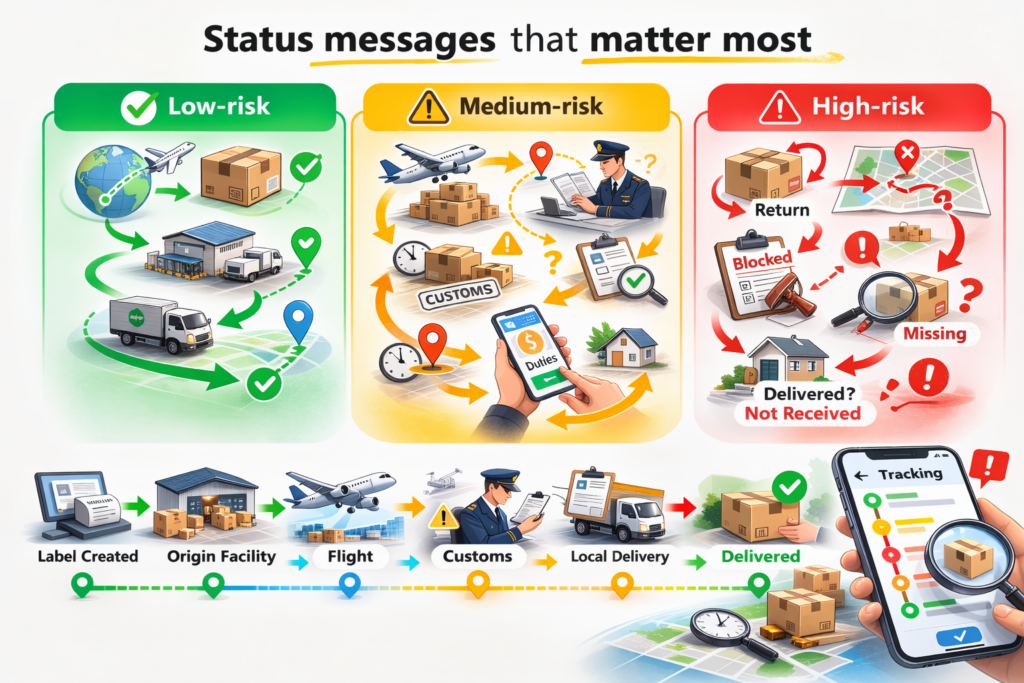
3,1 Bajo riesgo (normalmente normal)
- “En tránsito”
- “Instalación partida”
- “Llegada al centro”
- “Procesado en las instalaciones”
Concéntrese en el tiempo transcurrido desde la última exploración, no sólo en el enunciado.
3,2 Riesgo medio (vigilar de cerca)
- “Excepción” (leer detalles)
- “Dirección insuficiente”
- “A la espera del pago de derechos/impuestos”
- "Entrega intento”
Acción: solucionar el problema rápidamente (corrección de la dirección, pago, solicitud de nueva entrega).
3.3 Alto riesgo (actuar ahora)
- “Devolución al remitente iniciada”
- “Imposible de entregar”
- “Desaparecido / investigación”
- “Entregado” pero no recibido
Estos son los momentos para escalar inmediatamente.
4. Una sencilla lista de control de 3 preguntas

En seguimiento parece congelado, pregunta:
4.1 ¿Dónde está el último escáner?
- Escaneo previo a la aceptación → riesgo del lado del remitente
- Centro de exportación → cola de vuelos/capacidades
- Aduanas → trámites/inspección
- Después de las aduanas → brecha de traspaso de última milla
4.2 ¿Cuánto tiempo ha pasado desde la última exploración?
Desencadenantes prácticos:
- 5-7 días laborables: vigilar de cerca
- 10 días laborables: contactar con el servicio de asistencia
- Más de 15 días laborables: abrir una vía de investigación
4.3 ¿Coincide el estado con ese momento?
Ejemplo:
- “Salida de origen” durante 2-3 días es normal.
- “Salida de origen” durante 18 días es una señal de alarma.
5. Qué hacer cuando decides que no es normal
El plan de respuesta debe ser breve y disciplinado.

5.1 Verificar en varios sistemas de seguimiento
Compruébalo:
- Lugar de origen del transportista
- Sitio del transportista local (país de destino)
- Un rastreador multiportadora como Paquete postal
Diferentes sistemas pueden mostrar diferentes escaneos.
5.2 Reúna pruebas en minutos
Prepárate:
- Captura de pantalla de factura/pedido
- Dirección completa del destinatario + teléfono
- Captura de pantalla del historial de seguimiento
- Fecha de envío del vendedor y tipo de servicio
5.3 Contactar con la parte adecuada (en función de la etapa)
- Sin escáner de aceptación → vendedor/recogida en origen
- Retraso en la exportación → transportista de origen
- Retraso aduanero → transportista + destinatario (documentos/impuestos)
- Retraso en la última milla → mensajería/correo local
5.4 Si el seguimiento indica “Entregado” pero no lo ha recibido
Trátelo como urgente:
- Comprobar el buzón/la taquilla/la recepción/los vecinos
- Solicitar foto de entrega o prueba de GPS (si está disponible)
- Abrir un caso en 24-48 horas
- Notificar al vendedor si es necesario
6. Consejos rápidos de prevención que reducen los retrasos

6.1 Corregir el formato de las direcciones
- Incluya claramente el número de unidad/apartamento
- Hacer coincidir el código postal con la ciudad
- Añadir un número de teléfono localizable
6.2 Conocer las categorías “propensas a retrasos
Los retrasos se producen más con:
- Pilas (especialmente de litio)
- Líquidos/aerosoles/perfumes
- Alimentos/suplementos
- Artículos de marca restringidos en determinadas vías
6.3 Utilizar servicios de seguimiento para artículos urgentes
Prefiero servicios con:
- seguimiento de principio a fin
- exploraciones frecuentes
- visibilidad clara del traspaso de la última milla
7. Conclusión
Paquetería internacional El retraso en el seguimiento se convierte en una verdadera preocupación cuando el paquete permanece demasiado tiempo en una etapa, o cuando el seguimiento muestra excepciones como devolución, imposible de entregar o entregado-pero-perdido. Base su decisión en la última ubicación de escaneado y en los umbrales de días laborables. A continuación, verifique el seguimiento entre los transportistas, reúna sus pruebas y póngase en contacto con la parte que controla la etapa actual. Postalparcel facilita esta tarea mostrando la ruta completa y el último escaneado significativo en un solo lugar.



Perspectivas del sector

noticias vía inbox
Nulla turp dis cursus. Integer liberos euismod pretium faucibua