
International Parcel Tracking Delay: When Should You Start Worrying?
目录
国际包裹追踪 Delay is common with cross-border shipping. The real question is simple: is this a normal slow phase, or a real risk like a missed scan, a customs hold, or a handoff problem? Use this guide to read the signals, judge the timeline, and take the right action fast.
1. What an “International Parcel Tracking Delay” really means

一个 国际包裹追踪 Delay is not one single problem. It’s a label for “no update” or “slower than expected” during a trip that often involves multiple hubs, different carriers, and handoffs that don’t always create a scan. Sometimes the parcel is moving, but the tracking page stays quiet.
Most delays fall into one of these buckets:
- Scanning gap: the parcel moves, but no scan shows up yet.
- Queue delay: export flights, customs, or local sorting gets backed up.
- 例外情况: address issues, duties, return-to-sender, or a misroute.
1.1 Delay vs stuck: the quick difference
- Delay: tracking still matches the route, just slower.
- Stuck: no new scan for too long at a stage where scans are normally frequent.
2. Normal timelines (and when to worry)
These ranges help you stop guessing. Count business days when possible.
2.1 Label created, but no “accepted” scan
- Normal: 1–4 days
- Worry: 5–7+ days
What it often means: the seller printed a label but has not handed it over, or the drop-off point scans slowly.
What to do:
- Ask the sender for drop-off proof or pickup confirmation.
- If nothing changes after 7 days, request a reship/refund path.
2.2 Export processing (origin country)
- Normal: 2–7 days
- Worry: 10–14+ days
Common statuses:
- “Accepted at origin facility”
- “Processed at export hub”
- “Handed over to airline”
What to do:
- Check for any “departed” or “linehaul” update.
- If it hits 14 days, contact the origin carrier or seller.

2.3 Transit / flight stage
- Normal: 3–10 days
- Worry: 12–20+ days with no arrival scan
What it often means: indirect routing, flight capacity limits, weather, or batch scan uploads.
What to do:
- If there is no “arrived at destination country” after ~20 days, escalate.
2.4 Customs (destination country)
- Normal: 1–5 business days
- Worry: 7–10 business days, or repeated “clearance” loops
What to do:
- Double-check recipient name, phone, and address details.
- Watch for duties/tax requests or document requests (invoice/order proof).
- If it stays in customs beyond 10 business days, open a case.
2.5 After customs, no local movement
- Normal: 1–4 days
- Worry: 5–8+ days after “released from customs”
What to do:
- Track on the local post/courier website (sometimes it shows extra scans).
- If nothing changes after a week, contact the last-mile 载体.
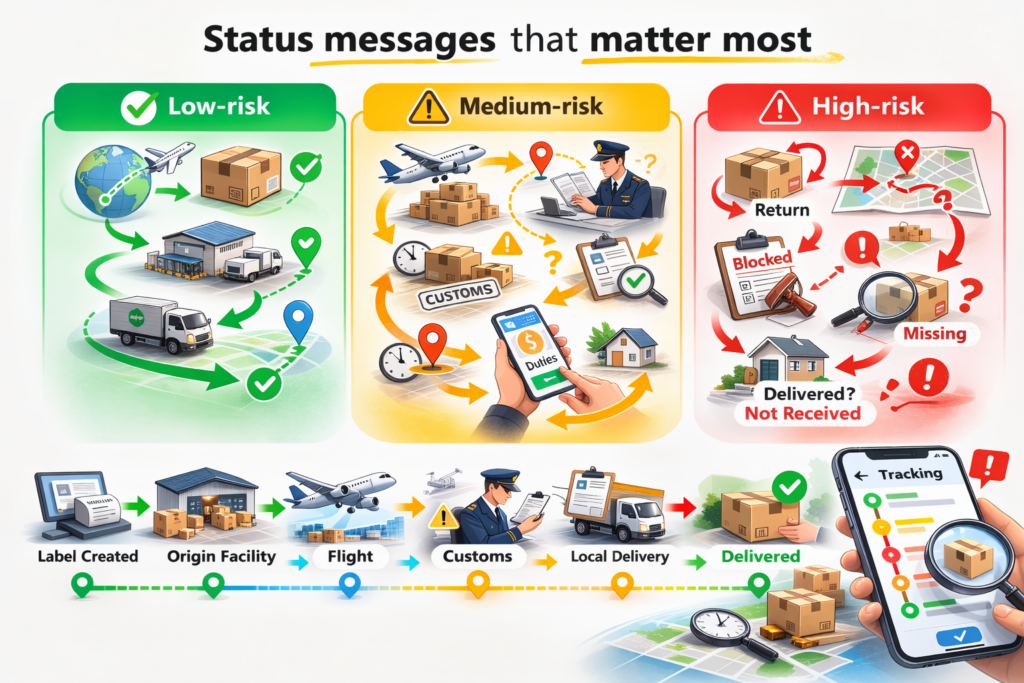
3. Status messages that matter most

3.1 Low-risk (usually normal)
- “运输途中”
- “Departed facility”
- “Arrived at hub”
- “经设施处理”
Focus on time since the last scan, not the wording alone.
3.2 Medium-risk (watch closely)
- “Exception” (read details)
- “Insufficient address”
- “等待缴纳关税/税款”
- "送货 attempt”
Action: fix the issue fast (address correction, payment, redelivery request).
3.3 High-risk (act now)
- “Return to sender initiated”
- “Undeliverable”
- “Missing / investigation”
- “Delivered” but not received
These are the moments to escalate immediately.
4. A simple 3-question decision checklist

何时 追踪 looks frozen, ask:
4.1 Where is the last scan?
- Before acceptance scan → sender-side risk
- Export hub → flight/capacity queue
- Customs → paperwork/inspection
- After customs → last-mile handoff gap
4.2 How long since the last scan?
Practical triggers:
- 5–7 business days: monitor closely
- 10 business days: contact support
- 15+ business days: open an investigation path
4.3 Does the status match that time?
例如
- “Departed origin” for 2–3 days is normal.
- “Departed origin” for 18 days is a red flag.
5. What to do when you decide it’s not normal
Keep the response plan short and disciplined.

5.1 Verify on multiple tracking systems
检查:
- Origin carrier site
- Local carrier site (destination country)
- A multi-carrier tracker like 邮政包裹
Different systems can show different scans.
5.2 Gather proof in minutes
准备
- Invoice/order screenshot
- Full recipient address + phone
- Tracking history screenshot
- Seller ship date and service type
5.3 Contact the right party (based on stage)
- No acceptance scan → seller/origin pickup
- Export delay → origin carrier
- Customs delay → carrier + recipient (docs/tax)
- Last-mile delay → local courier/post
5.4 If tracking says “Delivered” but you didn’t receive it
Treat this as urgent:
- Check mailbox/locker/front desk/neighbors
- Request delivery photo or GPS proof (if available)
- Open a case within 24-48 小时
- Notify the seller if required
6. Quick prevention tips that reduce delays

6.1 Fix address formatting
- Include unit/apartment number clearly
- Match postal code with city
- Add a reachable phone number
6.2 Know “delay-prone” categories
Delays happen more with:
- Batteries (especially lithium)
- Liquids/aerosols/perfume
- Food/supplements
- Restricted branded items on certain lanes
6.3 Use tracking-friendly services for urgent items
Prefer services with:
- 端到端跟踪
- frequent scans
- clear last-mile handoff visibility
7.结论
International Parcel Tracking Delay becomes a real worry when the parcel stays too long in one stage, or when tracking shows exceptions like return, undeliverable, or delivered-but-missing. Anchor your decision on the last scan location and business-day thresholds. Then verify tracking across carriers, gather your proof, and contact the party that controls the current stage. Postalparcel makes this easier by showing the full route and the last meaningful scan in one place.
行业洞察
收件箱消息
Nulla turp dis cursus.整体释放,预留空间